












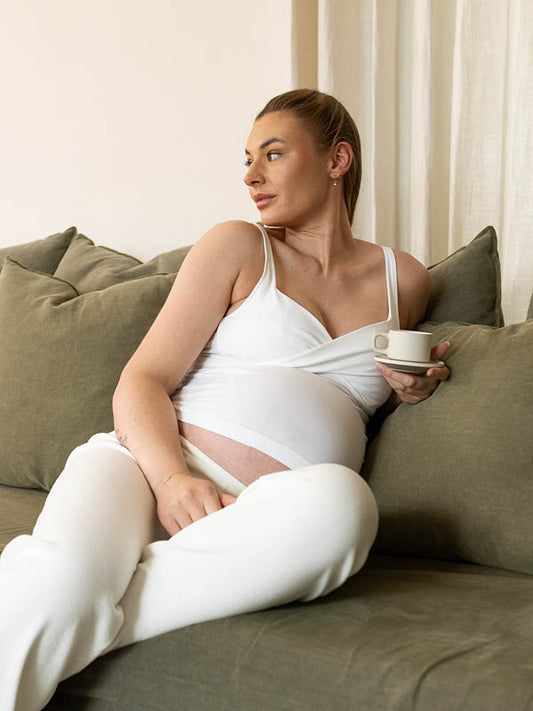

















// M.MAGAZINE X DR MARIAM CHALAAN
--- On hormonal shifts ---
Please tell us a little bit about yourself?
My name is Dr Mariam Chaalan. I'm a GP with a passion for women's health which is a polite way of saying I spend a lot of time being angry about how under-researched and under-served women are in medicine, and trying to do something about it. I co-host the Well by Mamamia podcast, and I share health content on Instagram and TikTok (@ask.the.dr) because I genuinely believe that access to good medical information shouldn't depend on who your doctor is or how long your appointment is. Most importantly I am a mumma and newly postpartum with a newborn and twins at home.
What are some of the biggest changes / challenges you've experienced as a woman during motherhood?
Honestly? The identity part. Nobody told me I'd grieve a version of myself while simultaneously falling completely in love with this new life. With my twins, I thought I'd figured it out and then we had our third and I was back at zero. The mental load is relentless. It's not just the physical exhaustion; it's the fact that your brain never fully clocks off. I'll be in the middle of a consultation and suddenly remember we're almost out of nappies. It's constant. And I think the hardest thing for me personally has been learning to receive help. I'm a doctor. I'm supposed to have answers. Admitting I'm underwater too; that's been the real work.
What are some of the most profound physical changes that happen to a woman's body during pregnancy that we may not know about?
Oh, where do I start.
Your plasma volume increases by up to 50% during pregnancy. Your heart is pumping harder from as early as ten weeks. Not harder as in you pushed yourself at the gym. Harder as in your entire cardiovascular system has been asked to run a completely different operation, quietly, while you're just trying to get through the day.
Then there's relaxin. Everyone knows it loosens your pelvis for birth, but nobody tells you it doesn't stay in your pelvis. It travels. And one of the places it travels to is your feet, where it loosens the ligaments that hold your arch together. Studies have documented foot length increases of up to a centimetre during pregnancy, and for many women that change is permanent. You can go up a full shoe size and never come back. Most women find this out when they're standing in their old shoes wondering why they hurt.
Your ribcage expands. Your stomach gets pushed upward, which is why reflux in the third trimester isn't just uncomfortable, it's almost guaranteed. Your abdominal muscles can separate down the midline, something called diastasis recti, and prevalence in late pregnancy approaches 100%. A third of women are still affected at twelve months postpartum and most of them have never been assessed for it.
And then there's the thing that stops people mid-conversation when I tell them. Your brain remodels. Grey matter volume and cortical thickness measurably decrease throughout pregnancy. Before you panic, researchers describe this not as damage but as a refinement, the same kind of neural pruning that happens in adolescence when the brain becomes more specialised. But here's the part that matters: for many women, those changes are still detectable years later. Pregnancy doesn't just temporarily rearrange your body. It rewires your brain.
--- A six-week check is not enough. It never was ---
Can you give us a snapshot of what a woman can experience hormonally — during pregnancy, preparing for birth, and post-birth?
Hormones are running the entire show, the whole time.
During pregnancy, oestrogen and progesterone are at the highest levels they will ever be in your life. They're sustaining the pregnancy, building the placenta, preparing your body for birth and feeding. Then labour starts and oxytocin and prostaglandins take over. And then the moment your placenta delivers, oestrogen and progesterone fall off a cliff. That drop is one of the sharpest hormonal shifts the human body ever experiences - and it happens right when you're also holding a new baby, running on no sleep, and expected to just... cope. The "baby blues" in those first few days? That's biology. Prolactin rises to make milk, cortisol spikes from sleep deprivation and stress and you're just in the middle of all of it, trying to figure out how to do a wrap swaddle.
Do hormone shifts occur long after giving birth? And why is it important to know this?
Yes, and I wish every woman was told this before she left the hospital.
If you're breastfeeding, your oestrogen stays suppressed for as long as you're nursing. That means vaginal dryness, low libido, joint aches, brain fog, low mood. Not because something is wrong with you. Because of a very specific hormonal mechanism that nobody warned you about, and that there are actually things to help with.
Your thyroid can also go haywire in the first year postpartum, affecting around one in ten women. It often gets missed because the symptoms, fatigue, weight changes, anxiety, low mood, look exactly like having a newborn. But there's a difference between tired and undertreated.
Iron is another one. Birth involves significant blood loss, and if you're also breastfeeding, your stores take a real hit. Crushing fatigue, breathlessness, poor concentration. Worth checking, because it's fixable.
And then there's the hormonal cliff that happens when progesterone drops after delivery. For women who are sensitive to that shift, it can tip into real anxiety and low mood, not just the baby blues.
The point is this: so many women are sitting with symptoms that have a name, a cause, and a treatment, and they're being told to push through. You don't have to. Get the blood tests. Ask the questions. You deserve more than a six week check and a wave goodbye.
What is "baby brain"?
It's real, first of all. Not a myth, not an excuse. During pregnancy, the brain genuinely changes; grey matter shifts, neural pathways reorganise, and the areas related to reading social cues, detecting threat, and attuning to another person's emotional state become more active. Your brain is literally restructuring itself to help you mother. So yes, you might forget words mid-sentence or put your keys in the fridge but you've also developed a heightened capacity to read your baby's needs that no one else in the room has. It's a trade-off. And honestly, once I understood that, I stopped being so hard on myself about it.
You've spoken about brain re-wiring — can you talk us through this?
Does it tie into matrescence?
So the brain changes of pregnancy driven by something called neuroplasticity, are actually long-lasting. Research published in Nature Communications has shown that structural brain changes persist well beyond the postpartum period. They're not a glitch, they're an adaptation. And yes, this ties directly into matrescence - a word I talk about a lot and still have to spell-check every time. It was coined by anthropologist Dana Raphael in the 1970s and it describes what I think is one of the most significant and under-acknowledged transitions in human life: becoming a mother. Just like adolescence, it involves profound psychological, physical, and identity transformation. You are not who you were before. You're not supposed to be. And the sooner we give that transition the weight and dignity it deserves rather than expecting women to "bounce back" the better.
Do you feel there's an important shift in society — one that focuses not just on the baby, but the mother too?
There is a shift, and it's long overdue. For so long, the mother was almost incidental to her own birth story; the goal was a healthy baby, full stop. But we now know that maternal wellbeing and infant outcomes are deeply connected. You cannot separate them. The fourth trimester is finally becoming part of the conversation. But do we need to educate more? Enormously. Not just in clinical settings but culturally. Mothers need to be held too. That's not a luxury, it's a health imperative.
Your tips for recovering gently post-birth?
Rest without guilt. I know that's easier said than done but your body has just done something genuinely extraordinary. Eat warm, nourishing food, and don't let anyone make you feel like you should be doing otherwise. Accept every offer of help. And if no help is offered, ask for it and loudly if necessary. Move gently when your body says yes; even a slow walk can do real things for your mood. See a pelvic floor physio; I recommend this to every single woman I see postpartum, vaginal or caesarean birth. And please see your GP before the six-week mark if something feels off. The six-week check isn't enough so go as often as you feel you may need. You deserve ongoing care, not a single sign-off.
We're so happy to see you in Mumma Milla! How has Mumma Milla supported you through the seasons of motherhood?
I've been wearing the camis since pregnancy and I'm still living in them now, postpartum.
The quality is genuinely something else and the ease of breastfeeding in them has been such a relief in those half-asleep, middle-of-the-night moments when you just need things to be simple.
But honestly?The fact that they also look good is what I keep coming back to. So much nursing wear feels like you're being handed a uniform; functional, fine, but not exactly something you'd choose. Mumma Milla doesn't make you choose between practical and pretty, and right now, when so much of my body and identity feels like it's in transition, that actually matters more than I expected.